

The Quiet Bear in the Room: Why Agriculture Can’t Afford Silence
If farmers don’t tell their own stories, someone else will. Kirbe Schnoor is making sure the microphone lands in the right hands.
Agriculture has a communication problem. For generations, the industry operated on a simple, unspoken agreement: producers grew the food, and the public ate it. The work happened in silence, often in isolation, and the results spoke for themselves at the grocery store. But in an era where information moves faster than a combine through wheat, silence is no longer a neutral stance. It is a liability.
"We do a poor job of advocating for ourselves," says Kirbe Schnoor, host of the national television series FarmHer and RanchHer. "We let other people tell our story and tell the facts and tell the truth when we should step up to the plate. If I'm not here to advocate for them, it's going be somebody who's not been a part of this industry."
Schnoor knows the stakes because she lived them. Growing up on an almond farm in Chowchilla, California, she watched her parents navigate the volatile rhythms of production agriculture in the Central Valley—a region that feeds the world while fighting for the water to do so. Today, she bridges the gap between the dust of the corral and the polish of national media, translating the grit of rural America for an audience that may never set foot on a farm.
The Reality Behind the Reel
We live in a curated world. Social media often reduces agriculture to golden hour sunsets, perfectly groomed livestock, and scenic harvest reels. While beautiful, this polish can obscure the brutal economic and emotional reality of the business. Schnoor argues that true advocacy requires showing the mud, not just the money shots.
"I think the biggest thing sometimes is the work looks like work," Schnoor tells “Your Ag Empire” host Jonathon Haralson. "And that scares people because it is."
During a recent shoot in New Mexico, Schnoor and her crew filmed in the snow and dirt, capturing a side of ranching that defies the romanticized Western myth. It was desolate, cold, and dirty. It was real. This willingness to expose the unvarnished truth is what builds trust with a skeptical public. Consumers are tired of being marketed to; they want to know that the steak on their plate came from a real place, raised by real people facing real challenges.
"If you're for everyone, you're for no one," Schnoor says, quoting advice from a friend. "You want people to not really think... 'she's for me, it's okay,' because that means you stand for nothing."
The Female Factor
Historically, the public face of agriculture has been male. The stoic farmer, the weathered rancher—these archetypes run deep. But behind almost every operation is a woman who is often the glue holding the business and the family together. Schnoor’s work with FarmHer and RanchHer highlights this often-overlooked demographic, revealing a shift in how the industry communicates.
Men in agriculture often feel the need to shield their families from the volatility of markets and weather. They carry the weight of generational legacy on their shoulders, often in silence. Women, Schnoor observes, are frequently the ones breaking that silence.
"It's broken families," she says, referencing the mental health crisis in rural America. "It's because it could be a very isolating industry... And women, I think, are more apt to tell the stories versus men."
By stepping into the spotlight, women in agriculture aren't just advocating for their operations; they are opening a critical valve for mental health conversations. They are admitting when the money is tight, when the stress is high, and when the "suck it up" mentality stops working.
California as a Warning Sign
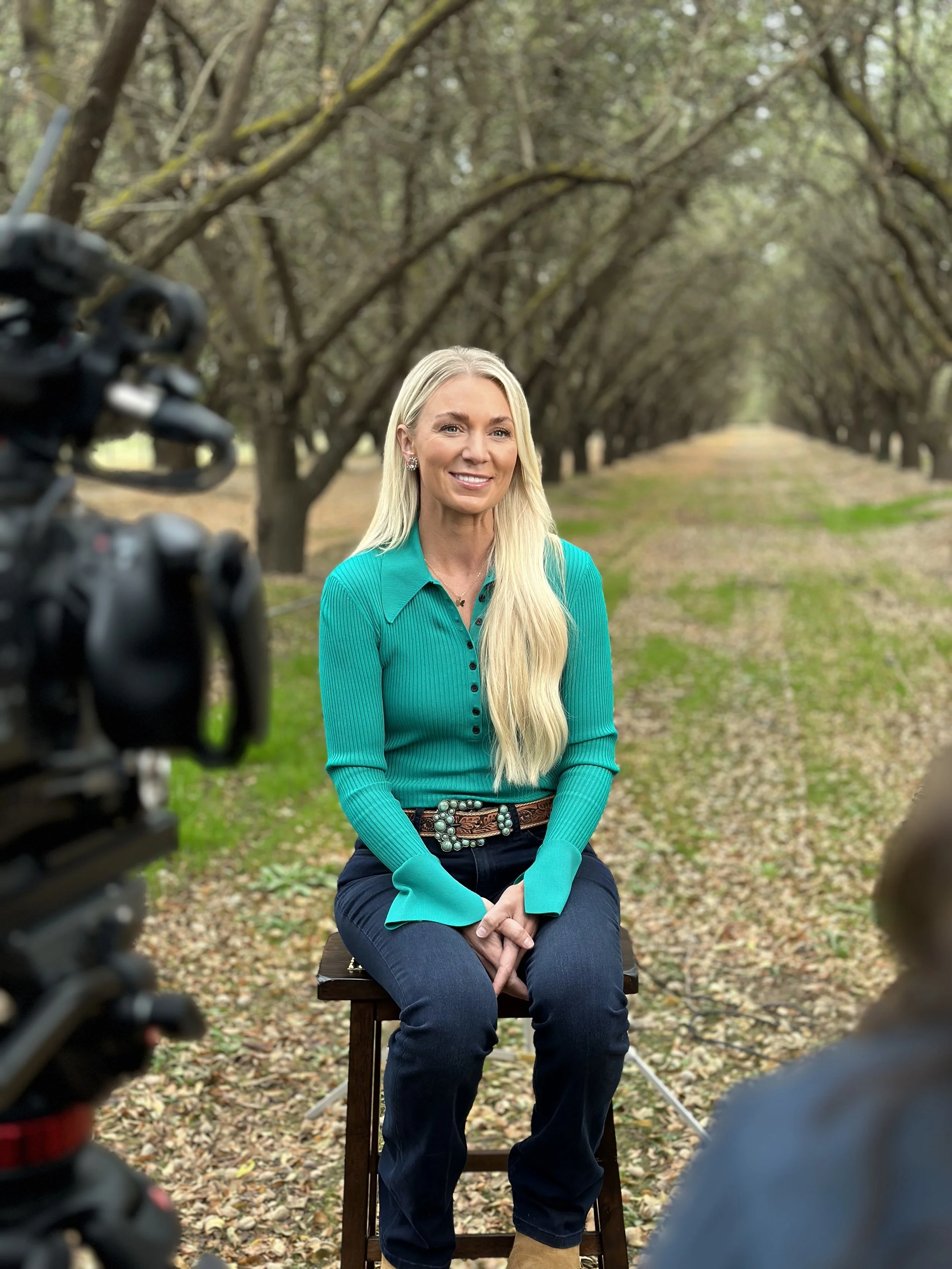
Kirbe Schnoor, host of the national television series FarmHer and RanchHer, grew up on an almond farm in Chowchilla, Calif., where she watched her parents navigate the volatile rhythms of production agriculture.
Schnoor’s background in California offers a sober warning for the rest of the country. The Central Valley is a powerhouse of production, churning out everything from almonds and pistachios to cotton and tomatoes. Yet, it is also a regulatory minefield. Water restrictions, labor laws, and skyrocketing land prices have forced many multi-generational families to sell out.
"We are getting a lot of international buyers that come in," Schnoor notes. "I think for us as Americans... if we were not in charge of our own food source and supply... that's a problem."
Haralson points out that California is often a bellwether for the rest of the industry. Regulatory pressures and land devaluation seen in the West often migrate to the Midwest and South within a few years. The consolidation squeezing California growers—where "big guys don't want to grow anymore just for the cost"—is a reality knocking on every producer's door, regardless of zip code.
The Next Generation’s Role
The future of agriculture depends on who is willing to show up. It requires a new guard of storytellers and operators who understand that tradition alone won't pay the bills. Schnoor encourages young people to leave their egos at the door and do the unglamorous work required to earn a seat at the table.
"I gave you guys this job on a silver platter, and nobody took it," she recalls telling a group of students who hesitated to go after an opportunity because the work looked too hard. "I was like, is it because it wasn't dressed up in sequins... It was hard."
The industry doesn't need more influencers chasing likes. It needs advocates willing to engage with a public that has lost touch with the land. It needs operators who treat their farms like businesses and their stories like assets.
"We're all afraid a little bit, I think, of criticism from the outside world," Schnoor admits. But the alternative—silence—is far more dangerous. If agriculture remains the "quiet bear," it risks being written out of its own history. The only way to ensure the American farm survives is to make sure its story is told by the people who live it.
